

October 5–11, 2026 · China AI #1
AIGC Weekly now focuses on China AI. Each issue connects the week’s important developments with their implications outside China. Earlier issues, through #92, remain in the archive.
Our read this week: capital is expanding the ambitions of Chinese AI companies; product control and overseas deployment will show how much of that ambition reaches users.
This week at a glance
Capital: DeepSeek’s reported mega-round; Manus raises fresh funding after its separation from Meta.
Products and architecture: Vidu adds reference controls; DiffuSpace funds a diffusion-language-model challenger.
Overseas adoption: Ecosia considers open models through European infrastructure.
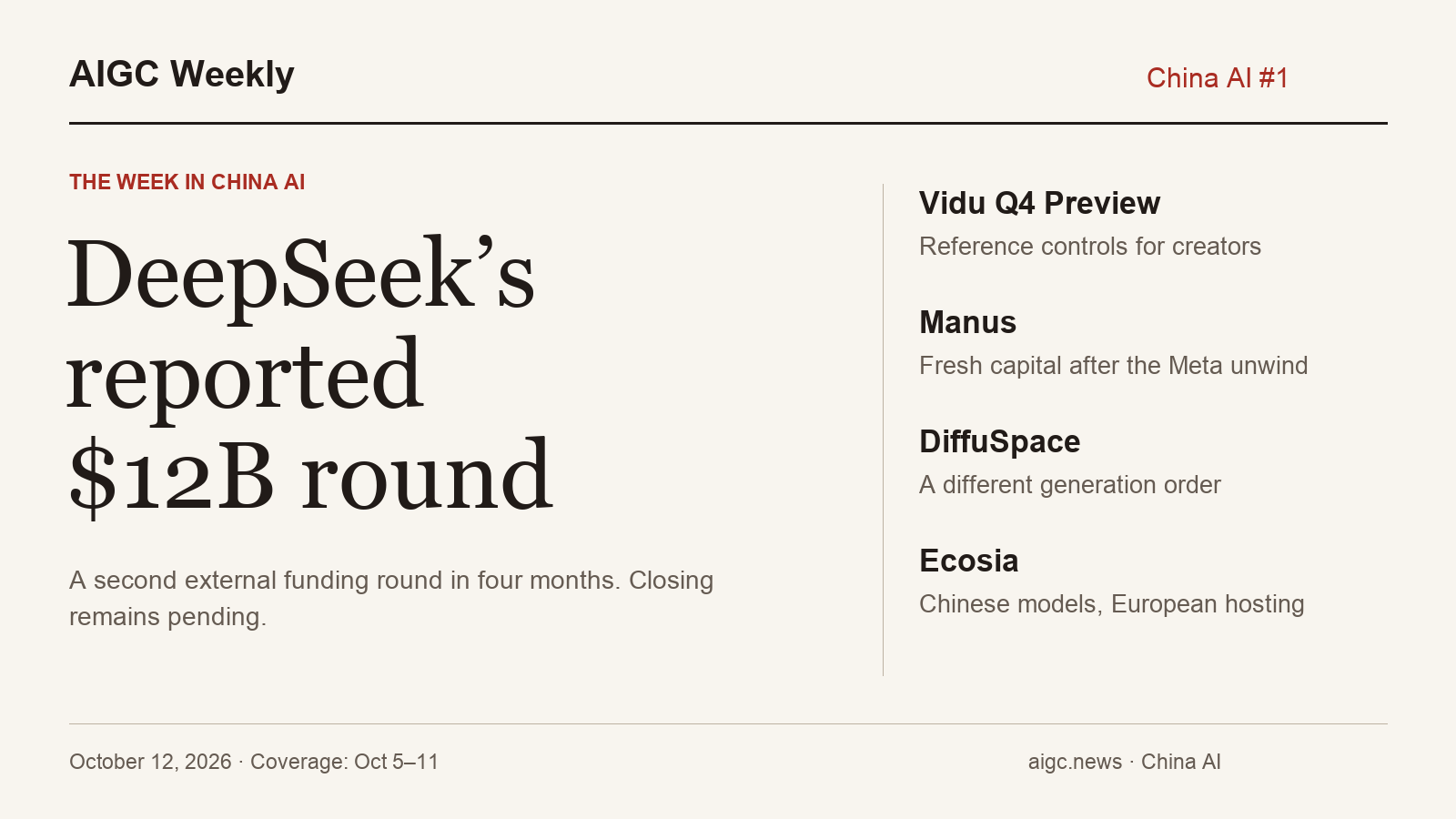
1. DeepSeek: a second external round in four months
Capital · October 6 · Reported; closing pending
Reuters reports that DeepSeek is set to raise more than RMB 80 billion—about $11.93 billion. Sources expect an October close; DeepSeek had not commented. The report follows its approximately $7.4 billion first external raise in June and says commitments exceed the new round’s original RMB 50 billion target.
The change is the pace of external financing: a second large round within four months would give DeepSeek a much larger capital base. For competing labs, its funding capacity becomes another factor alongside model quality and API prices. For infrastructure suppliers, an expanded budget is a potential opportunity, but orders and capacity commitments still need evidence.
Read more: DeepSeek’s funding push →
2. Vidu Q4 Preview: reference controls for recurring characters
Video · October 7 · Preview
ShengShu’s Vidu Q4 Preview supports up to 15 image references and three audio references, with advertised 2K/4K output and launch pricing starting at $0.014 per generated second.
The practical question is whether a creator can carry the same character, wardrobe, product and voice across several shots. Reference controls give studios more explicit inputs for those choices. If they reduce rejected takes, they could improve production economics even without a lower headline price. The starting rate alone does not establish the cost of an accepted scene.
Try this: make three shots with the same character and voice. Track continuity, retries and total spend per usable shot. Confirm the preview’s settings and plan before comparing costs.
3. Manus: fresh capital after the Meta unwind
Agents · October 8 · Company-announced financing
Manus’s parent, Butterfly Effect, said it completed a round exceeding $500 million, co-led by Boyu Capital and IDG Capital. Reuters and Shanghai Securities News covered the announcement. It follows Manus’s return to independent operations after Beijing ordered Meta to unwind its acquisition.
That sequence matters for overseas buyers and competitors: Manus’s ownership path has changed, while funding allows its standalone agent business to continue developing. The acquisition unwind shows why a China-origin agent company’s corporate structure deserves attention alongside its product capabilities.
For teams evaluating Manus, the useful diligence now includes which entity contracts with customers, the current data terms and how the service handles ongoing projects after the separation.
Read more: Manus’s financing and independent operations →
4. DiffuSpace: industrial capital backs a different generation order
Models · October 9 · Financing reported by independent outlets
ChinaVenture and STAR Market Daily report two completed DiffuSpace funding rounds, with Huawei’s Hubble and Horizon Robotics among the investors. STAR Market Daily puts the combined amount near RMB 500 million, citing people familiar with the company, and reports plans for a larger model release with open sourcing in October.
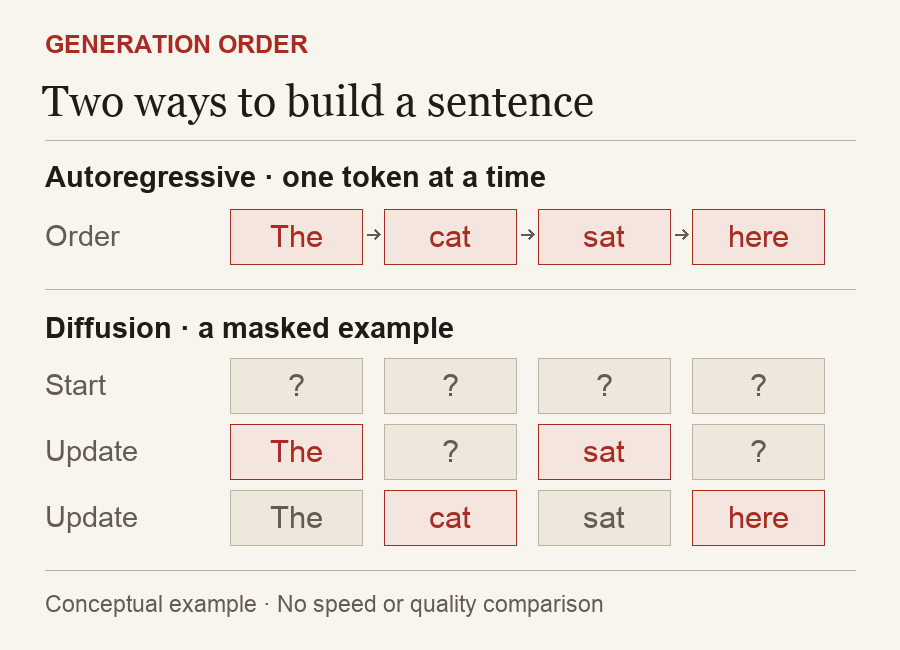
Diffusion language models can fill or revise multiple text positions through iterative updates. That offers a different approach to constrained editing and generation latency; any speed gain must be evaluated together with quality and the number of refinement steps.
Industrial investors make model-and-hardware fit worth watching, particularly for low-latency applications. Their participation does not establish a deployment contract. The team’s earlier Dream 7B is a 2025 release; this week’s news funds the next stage of development.
Read more: DiffuSpace’s diffusion-model bet →
5. Ecosia: Chinese models through European infrastructure
Overseas adoption · October 9 · Founder interview
Ecosia founder Christian Kroll explained its move away from Mistral in terms of affordable, efficient open models and said the company would probably use Melious.ai. The provider’s catalog includes Qwen, GLM and Kimi; it describes European hosting. The interview does not establish the model used for every response or confirm a completed migration of the whole service.
For Chinese labs, this points to a distribution route beyond their own APIs: overseas operators can host model weights and maintain the local customer relationship. For European buyers, it makes the model developer and inference provider separate procurement choices. Licensing, routing and data processing therefore need to be checked at both levels.
Read more: Ecosia’s model choices →
Briefly: Moonshot’s IPO watch
Bloomberg reports Moonshot at a $50 billion valuation, targeting a Hong Kong IPO in early 2027; company confirmation remains pending.
Read more: Moonshot’s valuation and IPO plans →
What to watch
DeepSeek: Will the reported $12B round close this month, and on what terms?
DiffuSpace: Will its next model arrive in October, and how will it balance speed and quality?
Ecosia: Which Chinese models will it use, and where will they run?